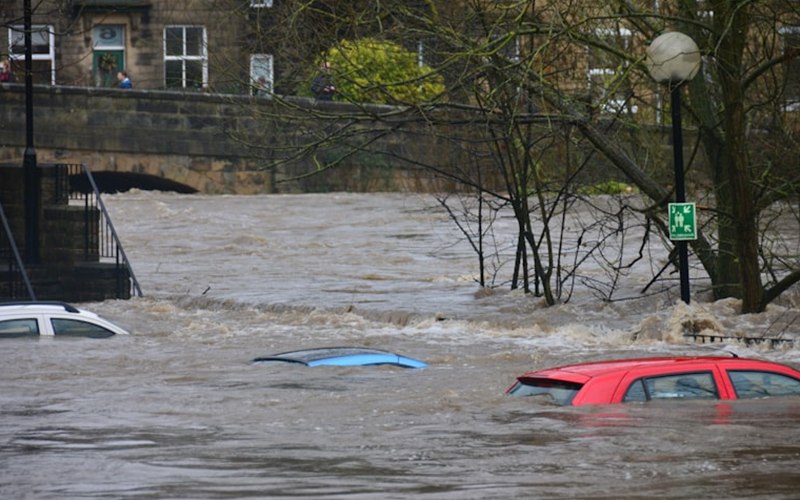
Flooding racks up billions in property losses across the country every single year. Even so, most homeowners carry no flood coverage at all, and a surprising number have no idea their regular homeowners policy spells out flood damage as an exclusion. Flood zone or not, getting a handle on flood insurance is essential to protecting both your house and your financial footing.
Why Your Everyday Homeowners Policy Falls Short
A standard HO-3 homeowners policy does respond to sudden interior water trouble -- a pipe that bursts, a washing machine that overflows. What it shuts out, across the board, is damage from outside flooding: a river jumping its banks, storm surge, rainfall that piles up, snowmelt running off. No major carrier is an exception to that exclusion.
That line in the sand matters more than people expect. If a hurricane tears at your roof and rain pours through the gap, your homeowners policy responds. But let that same storm drive a surge that swamps your first floor, and without a separate flood policy you're entirely on your own. Countless families ran headfirst into this gap during Katrina, Harvey, and Ian, when billions in flood damage went unpaid simply because the coverage wasn't there.
The National Flood Insurance Program (NFIP)
Washington launched the National Flood Insurance Program in 1968, with FEMA at the helm, so that homeowners in participating communities could actually buy flood coverage. It's still the country's leading source of flood insurance, carrying north of 5 million active policies.
NFIP Coverage Limits
The program splits coverage into two buckets, each with a hard ceiling:
- Building coverage: As much as $250,000 for a home's structure, reaching the foundation, the electrical and plumbing systems, HVAC gear, appliances, and built-in pieces such as carpet and cabinetry.
- Contents coverage: Up to $100,000 for your possessions -- furniture, clothing, electronics, portable appliances -- and you buy it on top of the building coverage.
- Basement restrictions: The NFIP keeps basement protection tight. Finished walls and floors, plus most belongings kept down there, fall outside the policy.
- No loss-of-use: Unlike a homeowners policy, the NFIP won't cover the cost of living somewhere else while your home is unlivable.
NFIP Against Private Flood Insurance
Private flood coverage has expanded a lot lately, giving homeowners a real alternative to the NFIP. Private insurers often bring higher limits, replacement-cost payouts rather than depreciated value, loss-of-use protection, and coverage for basement contents. Their premiums can match the NFIP or come in under it, particularly for homes sitting in moderate-risk areas.
That said, private flood policies aren't sold everywhere, and a number of mortgage lenders are still getting comfortable accepting them toward their requirements. Check with your lender first before you trade an NFIP policy for a private one.
Making Sense of Flood Zones
FEMA marks flood zones on its Flood Insurance Rate Maps (FIRMs) to signal how much risk a community faces. Knowing which zone you sit in drives both whether coverage is required and what you'll likely pay:
- Zones A and AE (high-risk): Spots with at least a 1% yearly flood chance -- the so-called 100-year floodplain. Carry a federally backed mortgage here and flood insurance isn't optional.
- Zones V and VE (coastal high-risk): High-risk shoreline areas exposed to storm surge and wave action on top of flooding. Premiums usually peak in these zones.
- Zone X (moderate-to-low risk): Ground beyond the 100-year floodplain. Coverage isn't mandatory but is well worth carrying -- tellingly, more than a quarter of all NFIP claims trace back to Zone X.
- Zone D (undetermined risk): Areas whose flood risk hasn't been studied. You can still buy a policy, but the pricing reflects that uncertainty.
Elevation Certificates: A Path to Cheaper Premiums
- An elevation certificate records where your home sits relative to the Base Flood Elevation (BFE) for your zone
- A house built above the BFE can earn markedly lower rates
- A licensed surveyor generally bills $300-$600 to produce one
- Even under FEMA's Risk Rating 2.0, elevation stays a major lever in how premiums are set
- Hang on to the certificate -- it travels with the property and can help whoever buys it next
What Drives the Price of Flood Coverage
Flood premiums swing widely depending on a handful of factors. Since FEMA rolled out its Risk Rating 2.0 approach in 2023, pricing mirrors each property's individual risk more precisely than it ever did:
- How close the water is. Nearness to rivers, coastline, lakes, and other water bodies is a leading rating factor.
- How high the home sits. Structures raised above the base flood elevation pay far less, and even a handful of inches can move the premium noticeably.
- The flooding track record. Homes with past flood claims, or in repeatedly flooded areas, draw higher rates.
- The building itself. Foundation style, story count, age, and whether living space sits on the lowest floor all factor into the price.
- Limits and deductible. Bigger coverage limits push the premium up; larger deductibles pull it down. NFIP deductibles run from $1,000 to $10,000.
A typical NFIP premium lands somewhere around $700-$900 a year, though high-risk homes can owe several thousand. In low-risk zones, the NFIP's Preferred Risk Policy can put coverage within reach for as little as $300-$500 annually.
The 30-Day Wait Before Coverage Begins
A detail that blindsides many homeowners is the waiting period. An NFIP policy generally doesn't take effect until 30 days after you buy it. You can't watch a storm roll in, grab a policy, and count on being covered -- which is exactly why planning ahead matters so much.
A few narrow exceptions exist: when flood insurance is tied to a new mortgage, coverage can start right at closing, and when a remapped boundary suddenly drops your home into a high-risk zone, you get a 13-month window to buy with only a 1-day wait.
How to File a Flood Claim
When flooding hits your home, the claim hinges on careful documentation and moving quickly:
- Call your insurer right away. Report the damage as early as you can; dragging your feet only muddies the claim.
- Capture all of it. Shoot plenty of photos and video before any cleanup begins -- waterlines on the walls, ruined belongings, structural harm.
- Set damaged items aside. Hold off on throwing anything out until the adjuster has seen it; move things to the garage or yard if you must, but keep everything.
- Head off further loss. Make sensible temporary fixes -- board broken windows, tarp a damaged roof -- and save every receipt.
- Sit down with the adjuster. The adjuster inspects the damage and drafts an estimate; go over it closely and hand over any extra documentation they ask for.
Flooding stands as the most frequent and most expensive natural disaster in the United States. Live near water or far from it, putting money toward flood insurance ranks among the wisest financial safeguards a homeowner can choose.